
Transforming Aquaculture with Real-Time Fish Weight Estimation
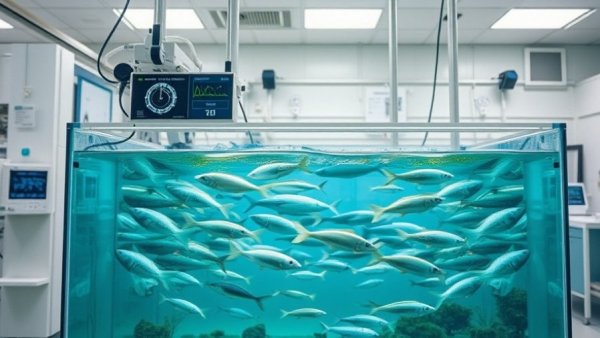
Innovation in aquaculture is crucial as the demand for sustainable fish farming continues to rise. Researchers from Sultan Qaboos University have introduced a groundbreaking technology called StereoGeoBox, which leverages underwater cameras to estimate fish weight in real time without needing intricate depth maps. This advancement is significant as it simplifies the monitoring process for aquaculture operations, allowing for efficient feeding, growth tracking, and harvest planning.
A Leap Forward in Underwater Imaging Technology
The traditional models for fish monitoring often faced challenges related to environmental conditions, such as reflections, bubbles, and murky waters. These factors made accurate measurements difficult and costly due to the need for substantial computational power. With StereoGeoBox, the researchers have developed a system that employs two synchronized cameras alongside AI algorithms to identify fish within their natural habitats without compiling extensive underwater depth data.
Boosting Accuracy with AI
By applying YOLO11 artificial intelligence, the system can recognize fish in paired images and calculate their dimensions by using their geometric relationships. The data on the fish's length and width is processed through an XGBoost machine-learning model that predicts their weight with impressive accuracy. This method not only shows efficiency but also maintains a balanced performance even in challenging environments.
Real-World Applications and Testing
The StereoGeoBox was tested with tilapia over a 15-month period across four growth stages. This practical approach allowed the researchers to analyze the system's performance thoroughly. In one test, for instance, a fish with a reference length of 15.30 centimeters yielded an estimate of just 15.25 centimeters, showcasing negligible estimation errors.
The system's capability to process about 25 frames per second with minimal latency indicates that it can be effectively utilized in commercial aquaculture settings. Such efficiency enhances real-time monitoring, which could lead to better management practices and healthier fish stocks.
Future Implications for Aquaculture
Despite these advances, there are still aspects to refine. The current prototype does not automatically count each fish, nor does it estimate the total biomass of an entire farm independently. Therefore, extending the research to include other fish species and various aquaculture environments will be vital for broader implementation.
As Dr. Said Al-Abri, a lead researcher involved in the project, points out, "By estimating depth only where fish are detected, StereoGeoBox reduces computational demands while retaining the speed and accuracy needed for real-time aquaculture monitoring." This statement encapsulates the potential impact of such technologies in paving the way for sustainable practices in the future.



Write A Comment