
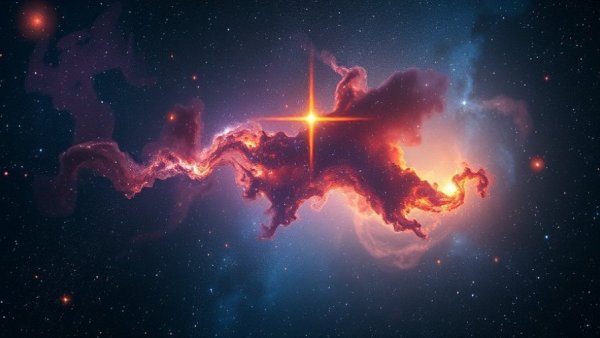
Unveiling the Mysteries of the Dragon Galaxy
In a stunning achievement, astronomers using the James Webb Space Telescope (JWST) have discovered 104 magnified stellar events in a galaxy known as the Dragon, located approximately 6.5 billion light-years away from Earth. This groundbreaking revelation, reported on November 8, 2026, represents a remarkable leap from the previous record of 44 detections within the same galaxy, indicating not only the advanced capabilities of the JWST but also the depth of insight it provides into our universe.
The Phenomenon of Gravitational Lensing
The Dragon galaxy, identified at a redshift of 0.725, does not simply exist in isolation. Its light is intricately manipulated through a process known as gravitational lensing, orchestrated by a massive galaxy cluster called Abell 370. This cluster stretches and magnifies light from the Dragon galaxy, resulting in optical phenomena like the captivating Dragon arc. As light travels through this cluster, its path is distorted by gravitational forces, illuminating parts of the galaxy that would otherwise be hidden from view.
A Unique Opportunity to Study Dark Matter
Beyond offering a glimpse of bright stars, these magnified events are pivotal in the study of dark matter. The distribution of dark matter in the universe is largely inferred from gravitational effects, making these observations critical to understanding its nature. The recent increase in detectable events not only allows for a more comprehensive analysis of the Dragon galaxy's stellar populace but also provides vital clues about the elusive dark matter that permeates the cosmos. Researchers such as José María Palencia and their teams have built models to analyze the gravitational effects meticulously, improving our understanding of these cosmic phenomena.
Exploring Stellar Events
The process by which these stellar events are observed involves meticulous image collection over multiple years. By comparing images taken at varying angles, astronomers can identify brightness shifts and transient events. These events, which last only days to weeks, highlight the dynamic nature of stars in the Dragon galaxy, showcasing their ability to brighten significantly as they cross through caustic lines of gravitational lenses.
Preparing for Future Discoveries
As scientists continue to employ advanced techniques and calibrate instruments for optimal performance, the JWST is set to revolutionize our comprehension of distant galaxies. The findings from the Dragon galaxy not only amplify the excitement within the astronomical community but also hint at future discoveries that could benefit fields ranging from cosmology to astrophysics. The data garnered helps to build a more elaborate map of the universe, raising questions about the fundamental forces at play.
What Lies Ahead in Cosmic Exploration?
With 104 events on record, expectations are high for even greater discoveries in space exploration. As researchers dive deeper into the intricacies of gravitational lensing and its implications, they pledge to further investigate how these findings can inform our understanding of dark matter, galaxy formation, and the complex tapestry of the universe at large. Each stellar event offers a unique narrative, stretching the limits of human understanding and technological capabilities.
Staying abreast of developments in space exploration and astronomical studies can inspire curiosity and inform individual perspectives on our universe. Engaging with this knowledge fosters appreciation for the intricate cosmic ballet that unfolds beyond our atmosphere.





Write A Comment