
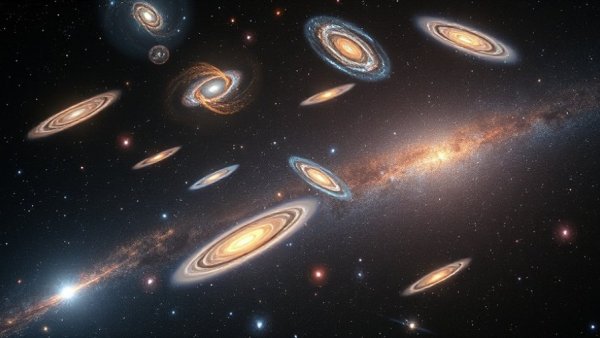
Exploring Cosmic Lenses: What Hubble's Findings Mean for Future Discoveries
Navigating the universe's mysteries is an adventure that never ceases to amaze astronomers. Recent revelations from NASA's Hubble Space Telescope bring us closer to comprehending the wonders of gravitational lensing, a phenomenon first predicted by Albert Einstein. This natural spectacle occurs when the gravity of a massive object warps the fabric of space, bending light from distant galaxies and creating intriguing arcs that hint at the presence of dark matter.
The Science Behind Gravitational Lensing
Gravitational lensing serves as a cosmic magnifying glass, allowing scientists to observe celestial phenomena that would otherwise remain hidden. As light from a more distant galaxy is distorted by the mass of a foreground galaxy, we gain valuable insights into both the visible and invisible components of our universe. The data collected by Hubble not only enhances our understanding of gravitational lenses but also helps us model the mass distribution of galaxies—including the elusive dark matter that makes up a significant portion of the universe's mass.
How the Nancy Grace Roman Space Telescope Will Enhance Our Understanding
The forthcoming Nancy Grace Roman Space Telescope, launched in August 2026, is designed to revolutionize our understanding of the cosmos with its wide field of view and infrared capabilities. While Hubble excels at providing high-resolution images of individual lenses, Roman promises to capture an expansive array of gravitational lenses. A narrower field of view may limit Hubble's reach, but its high-definition imaging will provide details on the small imperfections within lensed images that may indicate the presence of dark matter clumps.
The Intersection of Old and New in Astronomical Research
As Hubble's lenses yield important data, researchers aim to develop AI tools that will scan and analyze the vast array of images from the Roman Telescope. This intersection of old technology and new innovation illustrates the collaborative spirit that drives astronomical research. The combination of Hubble's precise imaging and Roman's broader perspective creates opportunities to explore the dark matter theory with greater accuracy. Insightful parallels can be drawn between these efforts and past advancements in the field, as scientists have historically leveraged technological progression to enhance their understanding of outer space.
Future Predictions: New Insights on Dark Matter
Leveraging these gravitational lens findings, researchers aspire to validate the existence of many small dark matter clumps, ranging from one million to one billion solar masses. This pursuit could provide monumental insights into the dark halo of our Milky Way galaxy, challenging or confirming existing theories about dark matter's role in cosmic structure formation. The quest to uncover these mysteries is not merely an academic endeavor; it carries implications for our understanding of fundamental physics and the evolution of the universe.
Why Understanding Gravitational Lenses Matters
Gravitational lensing is not just a theoretical concept; it has practical implications that could reshape our views on cosmic evolution and dark matter. As researchers navigate this frontier, the information gleaned will resonate beyond the realm of astrophysics and may one day influence technological and methodological advancements in other scientific fields. In times when the search for knowledge is paramount, experimenting with innovative ideas inspired by cosmic phenomena only enriches our quest for comprehension.




Write A Comment