
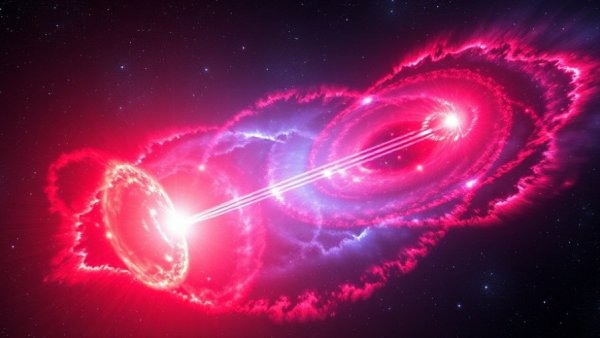
Understanding the Mystery of Centaurus A's Radiant Jets
Centaurus A, located about 12 million light-years from Earth, stands out not just for its proximity but also for its dramatic cosmic phenomena. At the heart of this galaxy lies a supermassive black hole, roughly 60 million times the mass of our sun, which unleashes two colossal plasma jets racing through the cosmos at nearly the speed of light. Despite the intuitive assumption that these jets should be brightest at their centers, observations made by the Event Horizon Telescope (EHT) reveal a surprising twist: the outer edges of the jets shine much more brightly than the core. This peculiar glow has puzzled scientists for decades, but recent research from the University of Würzburg sheds light on this cosmic mystery.
The Role of Plasma and Magnetic Fields
Plasma, the ionized gas that constitutes these jets, interacts with the galaxy's strong magnetic fields in unique ways. According to Felix Glaser, the lead author of the study, fast electrons spiraling along these magnetic field lines emit light in patterns determined by the orientation of the fields. The complex structure of the magnetic field creates bright edges and relatively dark cores, matching the striking patterns observed by EHT.
Connecting Micro and Macro: Insights From Simulations
This recent research not only clarifies why Cen A's jets are brighter at their edges but also connects phenomena occurring at the microscopic level of particles to vast structures that span several light-days. The simulations developed by the researchers correlate remarkably with the images captured by the Event Horizon Telescope at a wavelength of 1.3 millimeters, showcasing how tiny plasma effects can influence cosmic structures. Dr. Christian Fromm, a key figure in the study, emphasizes the necessity of integrating plasma physics into models of cosmic phenomena, as it could revolutionize our understanding of similar jets present throughout the universe.
Future Discoveries Await
This study opens a new avenue in astrophysical exploration, suggesting that the unique behaviors observed in Centaurus A might be recurrent across other relativistic jets. As more discoveries unfold through enhanced observation technologies, scientists anticipate revealing further plasma signatures that could help us decode the intricate dynamics of black hole jets. These findings may indicate that the principles guiding the jets of Cen A are not isolated, but instead, offer a glimpse into a broader cosmic narrative.
Conclusion: A Cosmic Laboratory
Centaurus A serves as a unique laboratory for scientists eager to unlock the secrets of black holes and their jets. Its proximity allows for detailed observation and intense study, expanding our understanding of the universe significantly. As we delve deeper into these cosmic phenomena, we will continue to uncover the stories that stars and black holes tell through their light—and perhaps redefine our place in the universe.





Write A Comment