
Unraveling the Mystery of Life Beyond Earth
In our quest to understand if we are truly alone in the cosmos, astronomers are deploying innovative strategies, like a groundbreaking computer simulation created by Samantha Gilbert-Janizek, a planetary scientist at the University of California, Riverside. This simulation focuses on depicting Earth as it would have been without life, shedding light on how to distinguish between habitable and inhabited planets.
A New Approach to Atmospheric Analysis
Life significantly alters a planet's atmosphere, evident through various gases produced biochemically. However, identifying these gases can be tricky since some can be emanated by both living organisms and geological processes. Gilbert-Janizek’s model enhances our understanding by simulating a lifeless Earth, revealing atmospheric changes that would occur without biological influence. This project builds on earlier work by Rory Barnes and integrates the planet’s core, mantle, crust, surface, and atmosphere into a singular robust model.
The Simulation's Power: Insight Into Habitability
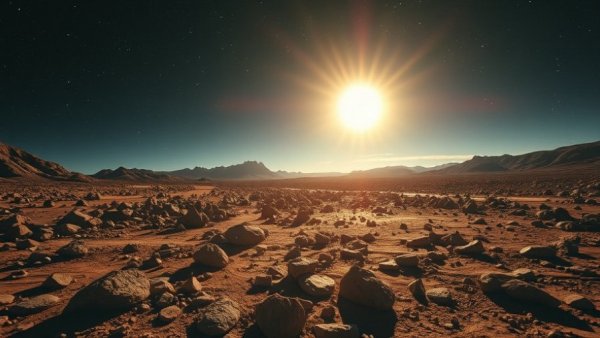
The simulation runs from Earth's conception 4.5 billion years ago to 500 million years into the future, producing insights into a lifeless world still characterized by oceans and atmospheres. This provides a baseline to compare exoplanets that exhibit signs of habitability. By applying specific characteristics of planets being studied, researchers can determine whether observed atmospheric features can be explained without invoking life.
Applications in Alien World Discovery
One of the simulation's most beneficial attributes is its “plug-and-play” functionality. Researchers can input a planet's properties into the model, letting it run and subsequently comparing its predicted atmospheric conditions against actual observations made by advanced telescopes like the James Webb Space Telescope. A match implies the absence of life, while discrepancies suggest the potential presence of biological activities influencing the atmosphere.
Implications for Future Research
While deviations won’t confirm life with certainty, Dr. Gilbert-Janizek's work represents a substantial advancement in our understanding of where life might exist in the universe. As Barnes noted, this model boosts confidence in future simulations of exoplanets, offering guidance to researchers about which worlds merit further study. The reliability of these simulations may influence upcoming missions aimed at identifying extraterrestrial life.
In summary, as our explorations extend beyond our planet, tools like Gilbert-Janizek’s simulation are imperative for unraveling the mysteries surrounding celestial bodies. Understanding the nuances of atmosphere evolution is crucial in determining the potential for life beyond Earth, paving the way for exciting discoveries in the vast expanse of space.




Write A Comment