
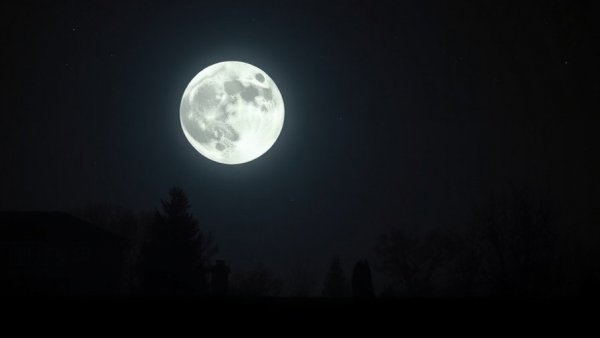
The Cold Moon: A Celestial Wonder to Witness
The December full moon, commonly referred to as the Cold Moon, reaches its peak illumination on December 23, 2026, at 8:28 p.m. EST (0128 GMT on December 24). This celestial event occurs when the moon aligns perfectly opposite the sun, illuminating the night sky with a remarkable glow. Typically named for the chilly temperatures that encompass the Northern Hemisphere during this time, the Cold Moon is not just an astronomical occurrence but an event steeped in cultural significance.
Why the Cold Moon Shines Brightly
This particular full moon will be distinguished as a 'supermoon,' as it coincides with the moon’s perigee, bringing it to a distance of roughly 221,667 miles (356,740 kilometers) from Earth. During such an alignment, the moon can appear up to 30% brighter and 14% larger than at its farthest point. Renowned astronomer Fred Espenak noted that this will be the closest supermoon of 2026, making it a spectacular sight for lunar enthusiasts and casual stargazers alike.
Moonrise and Viewing Tips for Enthusiasts
The Cold Moon is set to rise over the eastern horizon at sunset, providing a stunning view shortly before it achieves maximal brightness. In New York City, for example, moonrise occurs at 3:58 p.m. EST, providing ample opportunity for local viewers to catch a glimpse as the moon ascends. To enhance your viewing experience, consider using a moonrise and moonset tracker, which can be found on various astronomical websites. This is particularly useful given the unique optical effects at work when observing the moon near the horizon, where it may take on a mesmerizing golden-hued appearance.
Rich Cultural Heritage of the December Moon
Globally, the December full moon holds various names and cultural significance. The Mohican tribe of North America refers to it as the 'Long Night Moon,' emphasizing its connection to the winter solstice—the shortest day of the year. The Celts acknowledged it as the 'Oak Moon' because of their reverence for sturdy oak trees. The timing of this celestial event often enhances celebrations and festivals, coinciding with Hindu traditions like Datta Jayanti, which marks the birth of the deity Lord Dattatreya, and the Christian celebration of Christmas, underscoring the moon's multifaceted significance across cultures.
The Wider Celestial Landscape
Not only does the Cold Moon shine brighter during this winter month, but it also occupies a notable position within the 'Winter Hexagon,' a prominent grouping of bright stars including Sirius and Aldebaran. As the Cold Moon rises, it sets the stage for stunning night-sky viewing, allowing stargazers to enjoy a variety of celestial bodies accompanying it. Notably, Jupiter and Mars will be visible low in the eastern sky, while Venus will appear as the 'Morning Star' at dawn. Using stargazing applications can help you plot these celestial paths more accurately.
This Cold Moon not only reminds us of winter’s frigid breath but also serves as a reminder of our connection to the universe, fostering engagement with modern space exploration and the technological innovations surrounding it. From creating better telescopes to utilizing AI in astronomy, the avenues for exploration are boundless. As you prepare to experience this stunning natural event, consider how these developments in space and technology can enhance our understanding of the universe.





Write A Comment