
Exploring the Early Universe's Black Holes: A New Discovery
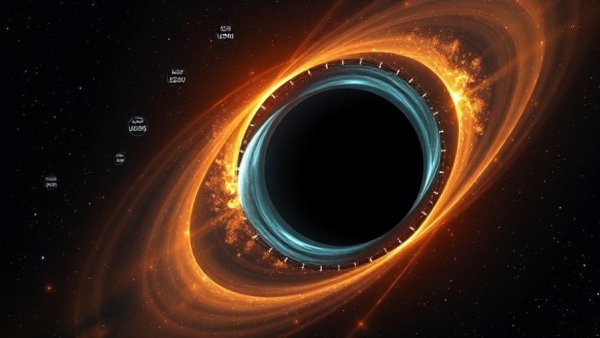
Recent findings from the James Webb Space Telescope (JWST) have unveiled a fascinating aspect of cosmic evolution—specifically, a black hole that appears to have grown faster than its host galaxy during the universe's formative years. This discovery sheds light on the origins of supermassive black holes and challenges our understanding of galactic formation.
Unveiling MARTA 3887: A Galactical Case Study
Located approximately 12 billion years in the past, the galaxy identified as MARTA 3887 presents a unique case for astronomers. With a stellar mass of around 145 million solar masses, it houses a black hole estimated to be 3.3 million solar masses. What sets this black hole apart is its mass in relation to the galaxy it resides in; typically, in observed galaxies, black holes constitute a much smaller proportion of their host's stellar mass, but here, it represents roughly 2.3% of MARTA 3887's stellar mass—a stark contrast to the 0.01% seen in more recent galaxies.
The Phenomenon of Overmassive Black Holes
Many recent studies have indicated that early black holes appear significantly heavier relative to their host stellar environments compared to what we see today. This pattern implies that in the early universe, black holes may have had a growth spurt exceeding that of their accompanying galaxies. The researchers note that only the most luminous or rapidly moving black holes are detectable, meaning that there may be many others that we have yet to observe.
Methodology: How the Discovery Was Made
The breakthrough analysis of MARTA 3887 combined data from multiple telescopes, such as JWST, Hubble, and the Very Large Telescope's MUSE instrument. By examining the gas dynamics through spectroscopy, researchers observed signs of black hole activity in the form of a wide emission line of hydrogen-alpha, signaling rapid gas movement. These observations indicate that the black hole's growth appears to have accelerated far beyond what typical stellar formation would suggest.
Future Implications for Understanding Cosmic Evolution
This discovery holds significant implications for our broader understanding of cosmic evolution and the role black holes play in galaxy development. As researchers examine more instances of overmassive black holes, they may be able to construct a clearer picture of how these extraordinary phenomena formed so early in the universe's history.
Ultimately, while this study helps to illuminate some of the mysteries surrounding black hole formation, the astronomers stress the importance of identifying smaller black holes as well. Understanding the full range of black hole masses and their connections to galactic structures will be crucial for piecing together the history of the universe.
If you're fascinated by the evolving dynamics of black holes and their impact on our comprehension of the universe, consider diving deeper into the latest discoveries in space exploration.




Write A Comment