
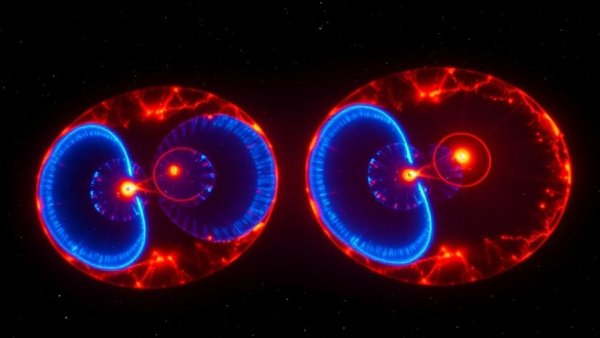
Bridging the 'MeV Gap' in Astronomy
In an exciting development for astrophysics, a team of scientists has utilized the Fermi Large Area Telescope (LAT) to address a longstanding challenge in gamma-ray astronomy, specifically in what is known as the "MeV gap." For over a decade, researchers struggled to identify sources within the crucial 20–200 megaelectronvolt (MeV) energy range. This gap has limited scientists' understanding of the universe's most energetic processes.
A New Era in Gamma-Ray Observation
The Fermi LAT team has combined 14 years of observation data with advanced statistical modeling techniques, yielding a comprehensive catalog known as the Second Catalog of Low-Energy Fermi-LAT Sources (2FLE). This catalog identifies 450 distinct gamma-ray sources, providing researchers with new insights into the cosmos.
The Identification Challenge
Traditionally, astronomers have had remarkable tools for observing both lower and higher energy spectrums. Instruments like the Chandra X-ray Observatory serve well in X-ray measurements, and the Fermi Gamma-ray Space Telescope captures high-energy gamma rays effectively. The uniqueness of Fermi-LAT lies in its ability to function more as a particle detector than a conventional telescope—struggling with lower-energy gamma rays that scatter randomly upon interaction with its layered structure of tungsten and silicon. This scattering complicates tracing back the origin of these photons.
Significant Findings from 2FLE
Out of the identified sources, nearly 377 have verified counterparts when compared to existing optical, X-ray, and radio data. Intriguingly, 325 of these sources reside outside the Milky Way, with flat-spectrum radio quasars (FSRQs) making up a substantial portion. These quasars, which are actively expelling energy, provide important insight into how matter behaves in high-energy environments around supermassive black holes.
Remarkably, the catalog also presents 52 sources located within our galaxy, predominantly pulsars—highly magnetized, rotating neutron stars emitting beams of electromagnetic radiation. Notably, the catalog highlights one significant discovery, with gamma-ray emissions traced back to the M2 globular cluster for the first time, marking a key advancement in our understanding of stellar remnants.
Unexplained Sources and Future Implications
Perhaps the most stimulating aspect of the 2FLE catalog is the 73 sources lacking discernible counterparts across different energies. These unidentified sources could potentially represent new phenomena or undiscovered objects in astrophysics, broadening our knowledge of the cosmos and challenging our understanding of energy emissions in space.
Conclusion: A Leap Forward in Astrophysics
The Fermi LAT's new findings symbolize a giant leap in astrophysical research, substantially closing the MeV gap that has hindered the field for years. By providing clearer data and revealing new sources, this research not only enhances our understanding of gamma rays but also opens a portal into the mysteries of the universe that lie waiting to be discovered.
This development encourages enthusiasts and professionals alike to delve deeper into space studies, pushing the boundaries of what we know about our universe and its energetic secrets.





Write A Comment