
AiTechDigest
update
AI Tech Digest
AiTechDigest
update
  • Home
  • Categories
    • AI & Machine Learning
    • Future Technologies
    • Tech Industry News
    • Robotics & Automation
    • Quantum Computing
    • Cybersecurity & Privacy
    • Big Data & Analytics
    • Ethics & AI Policy
    • Gadgets & Consumer Tech
    • Space & Aerospace Tech
  • All Posts
  • AI & Machine Learning
  • Future Technologies
  • Tech Industry News
  • Robotics & Automation
  • Quantum Computing
  • Cybersecurity & Privacy
  • Big Data & Analytics
  • Ethics & AI Policy
  • Gadgets & Consumer Tech
  • Space & Aerospace Tech
April 16.2025
3 Minutes Read

Unlocking Cosmic Secrets: Matter-Spewing Singularities May Redefine Dark Energy

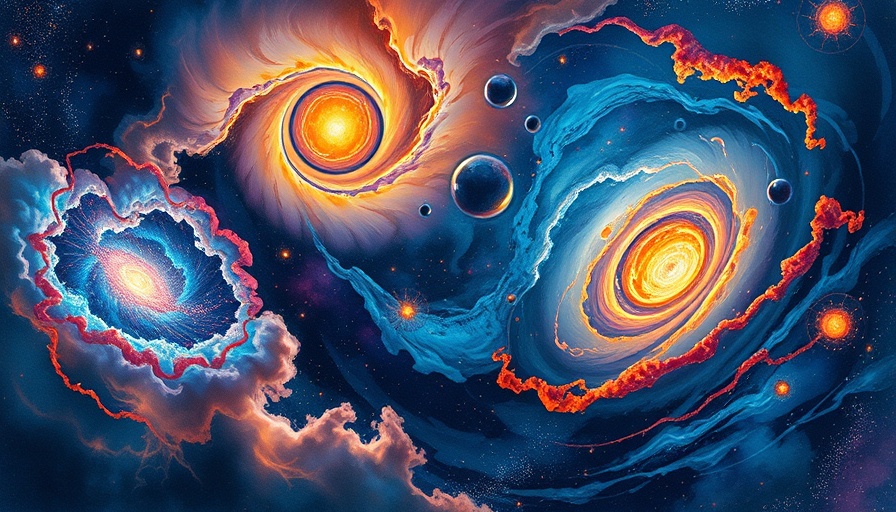
Abstract cosmic art illustrating dark energy and dark matter.

The Challenge of Dark Energy and Dark Matter

The universe, vast and enigmatic, has long presented scientists with a profound mystery known as the dark universe. Comprising approximately 95% of the cosmos, dark energy and dark matter are the unseen forces aiding in the expansion and structure of the universe. Despite their significant presence, little is known about them. This lack of understanding is highlighted by the fact that only about 5% of the universe is composed of ordinary matter, like stars and planets that we can observe and measure.

Introducing Transient Temporal Singularities

In an exciting development, a new theory proposes that the dark universe might not be necessary after all. Richard Lieu, a physics professor at The University of Alabama in Huntsville, suggests replacing dark matter and dark energy with what he calls transient temporal singularities. These singularities are hypothesized to create bursts of matter and energy that can cause the universe's fabric to stretch and expand. Unlike previous theories that relied on exotic concepts such as negative mass, Lieu's model aligns with existing conservation laws of physics.

Revolutionizing Our Understanding of the Cosmos

This potential shift in understanding could revolutionize cosmology by simplifying the complex models that scientists have had to build to account for dark energy and dark matter. Lieu's approach suggests that as these singularities occur at seemingly random intervals, they may not be detectable, leaving the observable universe to seem as if it is driven by dark forces that remain elusive. The new model aims to account for existing observational evidence while providing a clear alternative explanation.

Implications for Cosmological Models

If this theory holds, it could reshape our picture of cosmic evolution, allowing for a more unified understanding of how the universe began and how it has grown since the Big Bang. Moreover, this implies that gravity can operate independently of mass—an idea that challenges traditional views of physics.

Connecting Science and Space Innovation

This groundbreaking concept holds significant implications not just for theoretical physics, but also for space innovation. Understanding the true nature of the universe can aid technologies we develop for exploring outer space, satellite communication, and resource utilization beyond Earth. In aligning our perception of gravity and energy with observable phenomena, we might unlock new methods for space travel and even deep-space exploration.

The Broader Impact of Understanding the Universe

Beyond practical applications, this theory speaks to a deeper philosophical inquiry about our place in the universe. Engaging with such fundamental questions fuels human curiosity and drives innovation, urging us to explore the unknown. As we seek answers to these cosmic mysteries, we also spark interest in educational initiatives that inspire future generations of scientists and innovators.

In conclusion, while the quest to unravel the secrets of space continues, innovations based on the understanding of dark energy and matter may inspire new frontiers in scientific exploration. Understanding these dynamics enriches our comprehension not just of the universe but potentially of our role within it.

Future Technologies

9 Views

0 Comments

Write A Comment

*
*
Please complete the captcha to submit your comment.
Related Posts All Posts
07.07.2026

SpaceX's Falcon 9 to Launch 81 Satellites: The Future of Space Innovation

Update The Revolutionary Falcon 9: SpaceX's Continued Dominance in Space LaunchesOn July 7, 2026, SpaceX will once again demonstrate its prowess in the realm of aerospace technology with the Falcon 9 rocket aiming to deploy 81 satellites into low Earth orbit during its Transporter-17 rideshare mission. This continual innovation positions SpaceX not only as a market leader but also as a critical player in the evolution of satellite technology and global communications.Understanding the Launch: What Does It Entail?The Transporter-17 mission exemplifies the rideshare model, a business practice that allows multiple small satellites to share a launch vehicle, significantly reducing costs. This approach not only democratizes access to space for smaller companies and organizations but also fosters innovation within the technology sector by making satellite launches more affordable.Why 81 Satellites? Expanding Global ConnectivityThis particular launch will contribute to the growing constellation of satellites that enhance global internet connectivity. The increasing demand for data services, especially in remote areas, amplifies the necessity of reliable satellite networks like SpaceX's Starlink.SpaceX’s Track Record: Redefining Space ExplorationWith over 600 successful missions, SpaceX has redefined expectations within the aerospace industry. According to data, the Falcon 9 has achieved a remarkable success rate, making it the backbone of commercial space missions, including national security payloads and science research satellites.The Technology Behind Falcon 9: A Closer LookThe Falcon 9’s design leverages reusable rocket technology, allowing the first stage to return to the Earth, often landing on drone ships stationed in the ocean. This innovation not only enhances the efficiency of launches but significantly lowers the costs associated with space exploration, as seen with their recent pioneering efforts aimed at achieving a 100-launch year.Future Innovations: What’s Next for SpaceX?As SpaceX gears up for its ambitious plans for the decade, it is pivoting towards even more advanced developments. The upcoming launches include missions that support NASA's Artemis program and the potential deployment of new revolutionary communication satellites under Project Kuiper.Conclusion: The Future of Aerospace is BrightWith the Transporter-17 mission approaching, SpaceX is set to solidify its foothold in the aerospace industry. This upcoming launch not only marks another chapter in SpaceX's journey but will also pave the way for future technologies that tap into the potential of space exploration and utilization.

07.07.2026

Can Camera-Equipped Homing Pigeons Revolutionize Robotic Vision Systems?

Update Exploring Nature’s Lessons for Robotic Vision In an innovative blend of biology and technology, scientists are investigating how camera-equipped homing pigeons can enhance the capabilities of robotic vision systems in flight. Homing pigeons, renowned for their exceptional navigational skills, carry a unique feature that allows them to remain focused and oriented even in challenging environments. This research not only explores the potential of these birds but also delves into how mimicking their biological traits may lead to breakthroughs in robotic vision systems. The Fascinating Biology Behind Navigation Homing pigeons possess extraordinary sensory abilities, including keen eyesight and an exceptional sense of direction. These qualities arise from specialized adaptations in their visual systems that allow them to detect subtle visual cues from the environment. By analyzing how homing pigeons process visual information during their flights, researchers aim to inspire new algorithms and technologies for robotic systems. Biotech Innovations: Bridging Nature and Robotics The convergence of biology and biotechnology stands at the forefront of developments aimed at improving robotic systems. Innovations in this area highlight how understanding biological constructs can lead to technological advancements. For example, researchers are studying how the pigeons’ ability to navigate can be translated into algorithms for drones and other flying robots. This approach could significantly improve autonomous navigation, especially in complex urban environments where visual feedback is invaluable. Practical Implications and Future Trends As the applications for this technology unfold, it bears significant implications for various fields. From search and rescue operations to environmental monitoring, robots equipped with advanced visibility inspired by nature could revolutionize how we perform these tasks. Additionally, the development of more advanced flying robots could lead to enhanced aerial photography systems and even faster, more efficient delivery systems. Conclusion: Embracing Nature for Innovation The exploratory journey of integrating biological insights from homing pigeons underscores the exciting possibilities for future robotics. By tapping into the wisdom of nature, we can pave the way for smarter, more effective technologies. As we advance in this exciting landscape, it’s crucial to continue learning from biological models so we can foster innovation that aligns with our needs in an increasingly automated world.

07.05.2026

NASA's ERNEST Rover Revolutionizes Space Exploration with Innovation and Autonomy

Update NASA's New Rover Revolutionizes Space Exploration Navigating the rugged terrains of distant planets has always posed a significant challenge for NASA's robotic explorers. However, with the recent testing of the Exploration Rover for Navigating Extreme Sloped Terrain (ERNEST), NASA is ushering in a new era of planetary mobility. This advanced prototype, developed by the Jet Propulsion Laboratory (JPL), demonstrates remarkable autonomous capabilities and advanced design features that could redefine how future missions to the moon and Mars are conducted. A Breakthrough in Rover Technology During its recent 16-mile journey across the California desert, ERNEST showcased its ability to traverse complex landscapes with minimal human intervention. The rover completed its trek almost entirely autonomously, navigating through harsh conditions that would have left older rovers stranded. According to Issa Nesnas, a principal technologist at JPL, “This testing is helping us refine the mobility hardware and autonomy software,” emphasizing the importance of developing rovers that can adapt to extreme environments. Innovative Design Features Enhancing Rover Performance What sets ERNEST apart from its predecessors is its unique mobility system. Unlike older rovers like Opportunity and Perseverance that rely on a rocker-bogie system to navigate obstacles, ERNEST is equipped with a groundbreaking two-joint suspension system. This allows the rover to employ various gaits—think squirming and wheel-walking—enabling it to tackle even the most daunting terrains. The four-wheeled design facilitates side-to-side movements, giving it capabilities for agile maneuvering. Harnessing Artificial Intelligence for Autonomous Navigation Central to ERNEST's extraordinary performance is its artificial intelligence. The rover underwent extensive reinforcement learning in a virtual environment, amassing thousands of hours of experiential data in just days. This rigorous training enables it to identify and maneuver around obstacles in real-time while navigating diverse environmental conditions. This advancement may one day enable NASA to deploy rovers capable of considerably faster and more extensive exploration on the lunar and Martian surfaces. Future Implications for Space Exploration The implications of ERNEST's success are profound. As NASA prepares for ambitious future missions, having rovers like ERNEST that can effectively navigate previously unreachable terrains is crucial. James Keane, a JPL planetary scientist, summarized the rover's potential by stating, “You could do a science road trip across the Moon — or Mars — with this vehicle.” Moreover, the adaptations in mobility and speed are expected to streamline the exploration process, providing rich data that can enhance our understanding of these distant worlds. Conclusion: A Technological Leap Forward With the successful testing of ERNEST, NASA is not just pushing the boundaries of space exploration; it’s also setting a precedent for the innovation and adaptability required for future robotic missions. As technology advances, the prospects for deeper and more efficient exploration of our solar system continue to grow. It’s an exciting time for space enthusiasts and anyone interested in the future of exploration.

Terms of Service

Privacy Policy

Core Modal Title

Sorry, no results found

You Might Find These Articles Interesting

T
Please Check Your Email
We Will Be Following Up Shortly
*
*
*