
Add Row
Add Element
AiTechDigest
update
AI Tech Digest
AiTechDigest
update
Add Element
  • Home
  • Categories
    • AI & Machine Learning
    • Future Technologies
    • Tech Industry News
    • Robotics & Automation
    • Quantum Computing
    • Cybersecurity & Privacy
    • Big Data & Analytics
    • Ethics & AI Policy
    • Gadgets & Consumer Tech
    • Space & Aerospace Tech
  • All Posts
  • AI & Machine Learning
  • Future Technologies
  • Tech Industry News
  • Robotics & Automation
  • Quantum Computing
  • Cybersecurity & Privacy
  • Big Data & Analytics
  • Ethics & AI Policy
  • Gadgets & Consumer Tech
  • Space & Aerospace Tech
March 16.2025
2 Minutes Read

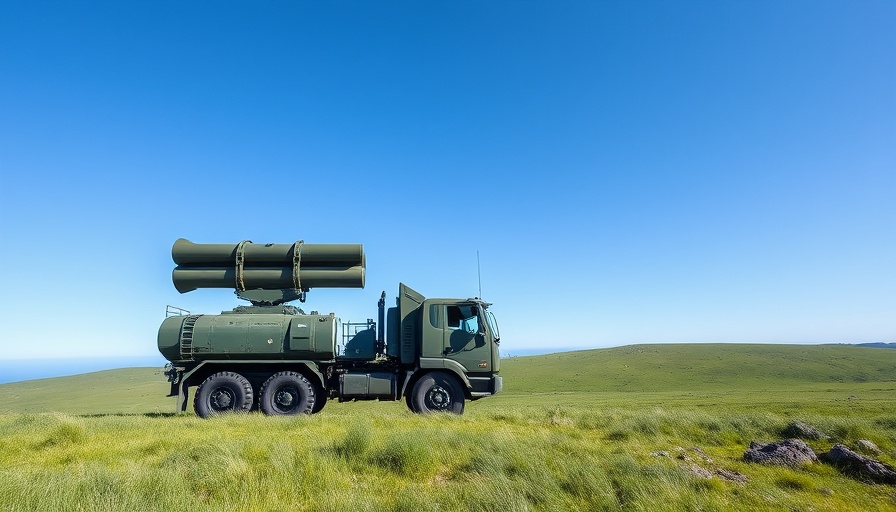
Ukraine's New 600-Mile Long Neptune Cruise Missile: A Major Military Advancement

Military truck with missile launchers under blue sky

Ukraine Unveils Long Neptune: A Game-Changer in Missile Technology

In a significant leap for its military capabilities, Ukraine has announced the deployment of the Long Neptune, a new cruise missile with an impressive range of up to 600 miles. This missile represents not only a technological advancement but also a strategic shift in Ukraine's ability to strike deep inside enemy territory during ongoing conflicts.

The Long Neptune: A Variant of Success

President Volodymyr Zelensky revealed the Long Neptune’s successful combat deployment after a test strike on March 14, aimed at an oil refinery in Russia's Tuapse, approximately 300 miles from Ukraine. The missile is an extended version of the original Neptune, which made headlines by sinking a key Russian warship, the Moskva, in April 2022. This enhancement allows the Long Neptune to hit critical targets well beyond previous limits, increasing Ukraine's potential for offensive operations against Russian infrastructure.

The Road to Independence in Military Production

Historically, Ukraine has relied heavily on foreign military support for its missile capabilities; however, recent geopolitical changes have pushed the nation to become more self-sufficient. The Long Neptune is developed domestically by the Luch Design Bureau, allowing Ukraine to reduce its dependency on international allies, particularly as the U.S. military aid hangs in the balance with changing political tides.

Strategic Implications of Long-Range Strikes

With the ability to strike targets as far away as Moscow, the introduction of the Long Neptune significantly alters the tactical landscape. This missile's development hints at Ukraine's broader strategy to maintain pressure on Russia's war machine and decrease production capabilities through targeted strikes. Experts suggest that if Ukraine continues its missile production ramp-up, it could alter the course of the ongoing conflict and provide leverage in future negotiations.

Potential Long-Term Effects on Regional Stability

The successful testing and deployment of the Long Neptune could heighten tensions between Ukraine and Russia. As Ukraine enhances its military capabilities, the risk of escalating violence in the region may increase. The missile's long-range capabilities will likely force Russia to reassess its military strategy, accounting for potential threats even from deep within Ukrainian borders.

As the war unfolds, the global community will be watching closely. The development of the Long Neptune not only reflects Ukraine's resolve to defend its sovereignty but also serves as a bellwether for the future of modern warfare, where domestic manufacturing capabilities can significantly influence combat strategies.

Space & Aerospace Tech

5 Views

0 Comments

Write A Comment

*
*
Related Posts All Posts
02.21.2026

Why the Debate Over AI in Warfare Matters: Anthropic vs. Pentagon

Update The Clash Between AI Ethics and Military Use The ongoing conflict between Anthropic, an AI development company, and the Pentagon highlights a critical debate over the ethical implications of artificial intelligence in military applications. This clash comes to the forefront as the Pentagon and Anthropic grapple over who should define the boundaries and uses of AI technology in warfare. With both parties holding vastly different perspectives on the integration of AI into military operations, this standoff raises broader questions about the future of defense, surveillance, and overall national security. The Stakes in Military AI Anthropic, known for its Claude language models, is hesitant to allow the Pentagon unrestricted access to its technologies, particularly regarding autonomous weaponry and surveillance of civilians. The company’s leadership, including CEO Dario Amodei, adheres to a philosophy that prioritizes safety and ethical standards above rapid deployment and operational efficiency. Meanwhile, the Pentagon insists on flexibility in using AI technologies to bolster national defense, viewing Anthropic's restrictions as a potential threat to operational military capabilities. Broader Implications for Global AI Policy This dispute is not merely a corporate argument; it reflects a fragmented discourse on the governance of AI in military contexts worldwide. Different regions adopt varied regulatory frameworks. For instance, the European Union has initiated comprehensive measures, like the AI Act, that explicitly exclude military applications. China, on the other hand, integrates AI into its defense strategies, often without public debate on ethical constraints. This disparate approach emphasizes the lack of a unified global standard in dealing with AI military application. Future Predictions for AI in Warfare Looking ahead, the nuances of this debate will likely shape the landscape of military technology and ethical policing. If corporations like Anthropic and government entities can find common ground, this may pave the way for balanced AI policy that prioritizes national security while safeguarding civil liberties. Conversely, escalating tensions could lead to a fragmentation of the tech industry, as firms either align with governmental demands or embrace strict ethical guidelines, possibly leading to unregulated competitors emerging from other regions. Conclusion — Understanding AI’s Role in Defense The current impasse between Anthropic and the Pentagon underlines the complex relationship between technological advancement and ethical responsibility. As AI continues to evolve, its integration into military strategy necessitates careful consideration from both private sector innovators and government regulators alike. Stakeholders must ensure that the deployment of AI technology not only enhances defense capabilities but also aligns with democratic values and respects human rights.

02.21.2026

Revolutionary Supercomputer Simulations Unveil How Rotation Drives Chemical Mixing in Red Giant Stars

Update Understanding Red Giant Stars Through Supercomputer SimulationsRecent advancements in computer simulations have illuminated the dynamic processes within red giant stars, particularly how rotation drives chemical mixing. These findings represent a significant leap in astrophysics, offering insights that challenge traditional models of stellar evolution.The Role of Rotation in Stellar ChemistryRed giant stars, typically at the later stages of their lives, exhibit unique chemical compositions that standard evolutionary theories struggle to explain. Research presented by astrophysicists has revealed that the rotation of these massive stars plays a crucial role in mixing elements throughout their interiors. This rotational mixing processes allows for the redistribution of chemical elements, potentially altering our understanding of stellar populations in the Milky Way and beyond.Implications of Chemical MixingThe striking findings suggest that rotation-induced mixing could be responsible for various abundance anomalies observed in these stars. For example, peculiar ratios of isotopes of carbon and lithium have led researchers to theorize the presence of unknown mechanisms at play. As researchers dig deeper, the implications expand beyond stellar chemistry, offering insights into the history of star formation and evolution in our galaxy.Bridging Theory and SimulationComputer models now provide a framework for predicting how rotation affects chemical mixing. Significant research relies on computer simulations that model red giants from their formation on the Zero Age Main Sequence through their evolution to the Red Giant Branch (RGB). These models incorporate factors like angular momentum and chemical transport within the star, providing a comprehensive understanding that has been missing from previous studies.Future Directions for ResearchLooking ahead, continued improvements in simulation technology are poised to enhance our understanding of chemical processes in red giants. Future predictions suggest that further study of these stars could lead to groundbreaking discoveries about their role in galactic chemical evolution. As we push the boundaries of astrophysical research, every simulation offers a clearer context regarding the life cycles of stars and their contributions to the universe.These revolutionary insights not only expand our understanding of red giant stars but also open new avenues for questions about the mechanics of the universe itself. As research progresses, the potential for groundbreaking discoveries in stellar evolution continues to grow, making it an exciting time in the field of astrophysics.

02.19.2026

Iran's Military Reality: Can Russian Mi-28s and Su-35s Make an Impact?

Update Examining Iran's Military Capability and Foreign Support In recent discussions about Iran's military prowess, the influx of Russian Mi-28 combat helicopters and Su-35 fighter jets has sparked significant interest. However, these additions may not provide the revitalization Iran's dilapidated military desperately needs. The potential of these advanced aerospace technologies raises crucial questions about their effectiveness in enhancing Iran's operational capabilities. The Limitations of Modern Military Equipment Even with modern hardware like the Mi-28 and Su-35, Iran's military faces systemic challenges. The need for comprehensive training, maintenance infrastructure, and logistical support far outweighs the mere acquisition of sophisticated weaponry. As experts have noted, effective military operations rely equally on human capital as much as on technology. Geopolitical Implications of Foreign Military Sales Russia's sale of military equipment to Iran could shift regional dynamics, but it's crucial to recognize that mere possession of advanced equipment does not guarantee improved combat efficacy. The interplay of international relations, sanctions, and regional conflicts complicates Iran's ability to leverage these assets effectively. Future Military Readiness: Evolution, Not Revolution Experts advocate that instead of solely focusing on foreign technologies, Iran must work on restructuring and modernizing its military processes. Investing in training programs, advancing strategic partnerships, and enhancing domestic capability development could yield better outcomes than simply acquiring new aircraft. In conclusion, while the Mi-28s and Su-35s symbolize a step towards modernization, the broader context of military readiness and efficacy reveals a complex landscape. Iran's path forward lies not just in modernization through foreign acquisitions, but in a comprehensive approach that revitalizes its military capabilities holistically.

Terms of Service

Privacy Policy

Core Modal Title

Sorry, no results found

You Might Find These Articles Interesting

T
Please Check Your Email
We Will Be Following Up Shortly
*
*
*