
Deciphering the Iconic Image of a Black Hole: What’s at Stake?
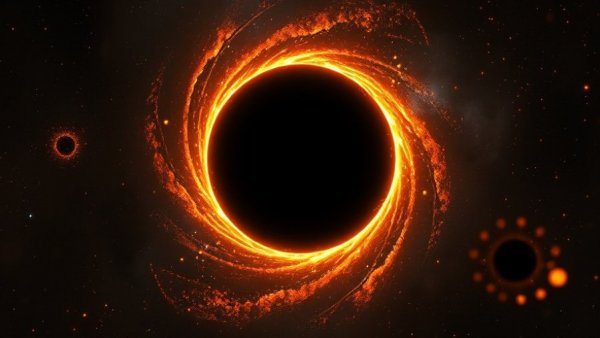
The Event Horizon Telescope (EHT) Collaboration shocked the world on April 10, 2019, when it unveiled the first-ever image of a black hole. This groundbreaking image depicted a black hole located at the center of the galaxy M87, approximately 55 million light-years from Earth. It effectively illustrated a black hole "shadow" that was outlined by light from furious swirling gas, aligning with the predictions of Einstein's theory of general relativity and reinforcing the notion that supermassive black holes undoubtedly inhabit the centers of galaxies.
However, scientific discourse surrounding the precision of this iconic portrayal has since emerged. After extensive analysis of the original data sets, a new study, published in the prestigious journal Nature, supports the initial findings while providing a fresh perspective on the ring's structure. This independent validation heightens confidence in what may be one of the most significant scientific milestones of our era.
Understanding the Complexity of Black Hole Imaging
Imaging the supermassive black hole in M87 is no small feat. Picture trying to capture a photo of a donut from the moon while standing on Earth—that's the kind of challenge astronomers face. The EHT managed to overcome this difficulty by combining data from radio telescopes positioned worldwide, effectively creating an Earth-sized telescope that allows for unprecedented imaging of the hostile environments surrounding black holes.
While various independent imaging teams within the EHT reported similar ring-like structures, discrepancies over finer details arose, due to human biases or inherent algorithmic discrepancies in the imaging processes. This is expected when integrating data from a sparse array of telescopes into a makeshift Earth-sized observatory. Additionally, intrinsic errors will also be introduced by individual telescopes during data collection, influenced by their instruments or external factors like the Earth's atmosphere.
Innovative Techniques Fueling New Insights
In response to these challenges, the researchers of the recent study introduced an innovative technique known as "closure invariants." Unlike standard practices that involve pairwise combination of telescope measurements, closure invariants incorporate triplet measurements. This approach not only mitigates errors linked to atmospheric and instrumental interference, but it also yields clearer insights into the structural nuances of the black hole.
To further maximize the information extracted from this data, a machine learning imaging method dubbed GenDIReCT has been utilized. This advanced technique ensures that the resulting images align with the measurements collected and enhances the interpretation of the black hole's surrounding phenomena.
The Significance of This Research
As we unravel the intricacies of celestial wonders like black holes, the implications resonate far beyond mere curiosity. Clarifying the imaging accuracy of black holes encourages a deeper understanding of fundamental cosmic principles, validating assumptions that shape our grasp of physics. Moreover, advancements in imaging techniques like closure invariants can revolutionize how astronomers investigate distant phenomena, ensuring that our explorations of the universe become more accurate and insightful.
Ultimately, the work done by researchers not only improves our comprehension of black holes but also fosters a sense of connection to the far reaches of the cosmos. As we gather sharper images and data of phenomena so distant, we bridge an understanding between humanity and the mysteries of space, awe-inspiring generations to come.





Write A Comment