
Add Row
Add Element
AiTechDigest
update
AI Tech Digest
AiTechDigest
update
Add Element
  • Home
  • Categories
    • AI & Machine Learning
    • Future Technologies
    • Tech Industry News
    • Robotics & Automation
    • Quantum Computing
    • Cybersecurity & Privacy
    • Big Data & Analytics
    • Ethics & AI Policy
    • Gadgets & Consumer Tech
    • Space & Aerospace Tech
  • All Posts
  • AI & Machine Learning
  • Future Technologies
  • Tech Industry News
  • Robotics & Automation
  • Quantum Computing
  • Cybersecurity & Privacy
  • Big Data & Analytics
  • Ethics & AI Policy
  • Gadgets & Consumer Tech
  • Space & Aerospace Tech
August 05.2025
2 Minutes Read

Is Using Force Against the Kurdish-Led SDF the Key to Stability in Syria?

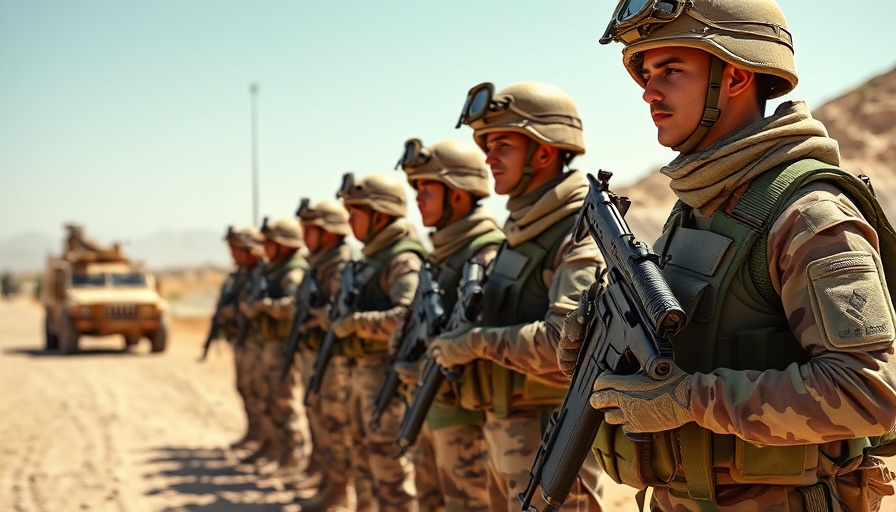
Kurdish-led SDF soldiers stand vigilant in Syrian desert.

Understanding the Kurdish-Led SDF: A Critical Force in Syria

The Syrian Democratic Forces (SDF), a U.S.-backed Kurdish-led group, play an essential role in the ongoing stability of Syria. Recently, they faced severe attacks from Islamic State militants and government-affiliated forces, raising concerns about their future and the broader impact on the region. As the foremost organization preventing a resurgence of ISIS in Syria, their stability is crucial to maintaining peace amidst ongoing conflicts.

The Risks of Military Aggression

Recent skirmishes in eastern Syria have highlighted the precarious position of the SDF. These violent clashes—over incidents involving rocket fire and civilian casualties—expose significant risks. Using force against the SDF could destabilize an already fragile environment and potentially reinvigorate ISIS. Maintaining the SDF's operational capacity is vital to counteracting ISIS activity; thus, supporting them entails recognizing and addressing the underlying issues that spark conflict.

The Dangers of Misunderstanding

Conflicts often arise from misunderstandings and a lack of coordination between regional military forces. The SDF and the Syrian government have exchanged blame for recent hostilities, indicating a dangerous disconnect. Without clear communication and defined boundaries, misunderstandings can escalate quickly, leading to unnecessary casualties and chaos.

Future Implications for Syria

The ongoing tensions point to a critical juncture for Syrian stability. If the SDF were to be significantly weakened, it could trigger a rapid deterioration of security and an increased likelihood of ISIS resurgence, affecting not only local communities but also implicating wider geopolitical relationships tied to U.S. interests in the region. The international community must consider the implications of their support—or lack thereof—on the SDF.

Your Role in Understanding These Events

Understanding the intricate dynamics at play in Syria is crucial for analyzing broader Middle Eastern geopolitics. By remaining informed about these developments, readers can engage in more meaningful discussions about foreign policy and security measures in the region.

Space & Aerospace Tech

2 Views

0 Comments

Write A Comment

*
*
Please complete the captcha to submit your comment.
Related Posts All Posts
04.08.2026

How Drones are Transforming Rescue Missions and Emergency Responses

Update The Evolution of Drone Rescue Missions The recent daring and costly rescue operation in the remote mountains showcased not only the potential of drones in emergency response but also highlighted the rapid evolution of drone technology in various professional fields. In an era where technology plays a pivotal role in our lives, the integration of drones into rescue missions is making headlines, illustrating their transformative impact in critical situations. Drones: A Game Changer in Rescue Operations During this rescue mission, drones were deployed to survey dangerous terrain and locate victims in record time, emphasizing their advantages over traditional methods. They provide real-time data, enhance situational awareness, and can access areas that are otherwise inhospitable for ground teams. This mission vividly demonstrates how drones can potentially save lives by enabling quicker and more efficient operations. The Cost Factor: Balancing Budgets and Benefits Despite the significant costs associated with deploying drones, the investment is often justified by the value they provide. As organizations weigh the expenses against the benefits, the growing consensus is that drones can enhance operational efficiency while reducing risks to human life. Understanding this cost-benefit dynamic is crucial as more industries adopt drone technology. The Future of Drones in Aerospace and Defense Looking ahead, the role of drones in aerospace and defense sectors continues to expand. They are not just confined to search and rescue efforts but are also utilized in surveillance, military operations, and logistical support. As advancements in drone technology continue, their applications will become even more diverse, pushing the boundaries of what is possible and fostering discussions around ethics and autonomy in drone operations. In summary, the integration of drones into emergency rescue operations marks a significant shift in how crises are handled. These technological advancements not only hold the promise of safer, more efficient responses but also spark vital conversations about their broader implications in the aerospace and defense industries.

04.08.2026

New Research on Graphene Aerogels: Unleashing Laser Propulsion in Space Exploration

Update New Research on Graphene Aerogels: Unleashing Laser Propulsion in Space Exploration In a groundbreaking experiment demonstrating the potential of graphene aerogels, researchers have proven that these ultralight materials can be propelled using lasers in microgravity conditions. Conducted during the European Space Agency's (ESA) 86th parabolic flight campaign, the findings could pave the way for innovative propulsion systems in future space missions. The Power of Microgravity Traditionally, the performance of engineering materials is strongly influenced by gravitational forces. However, the unique environment of microgravity, such as that achieved in parabolic flights, provides a distinct advantage. In this setting, graphene aerogels were subjected to targeted laser pulses, allowing researchers to closely observe their behavior. The exciting results indicated that, under microgravity, these aerogels experienced remarkable accelerations, reaching up to 1.7 m/s after only 30 milliseconds of laser exposure, compared to minor displacements under Earth’s gravity. Understanding Graphene Aerogels Graphene itself is a single layer of carbon atoms arranged in a two-dimensional lattice, known for its extraordinary electrical, thermal, and mechanical properties. When structured into aerogels, these advantages are preserved while achieving a material that is incredibly lightweight (with densities as low as 0.00016 g/cm³), highly porous, and adaptable for various applications. Their remarkable properties, such as high thermal conductivity and strength, make them ideal candidates for innovative technologies in aerospace. Laser-Induced Motion: Mechanisms Revealed The propulsion mechanisms revealed important insights into how energy from light can be used to induce movement. As described in the research published in Advanced Science, two key forces were identified: the Knudsen force and photophoretic force. The Knudsen force is generated through gas interactions with the porous aerogel, creating a pressure differential that drives motion, while the photophoretic force arises from the uneven temperature distribution created by laser exposure. In microgravity, the absence of friction and weight allows these forces to operate at maximum efficiency, significantly amplifying the propulsion effect. Applications in Future Space Missions These findings suggest exciting possibilities for the future of space exploration. The potential applications of laser propulsion could include solar sails, which harness sunlight for travel, and fuel-efficient attitude control systems for small satellites. By replacing traditional propellant-based propulsion methods, graphene aerogels may significantly reduce the cost and complexity of space missions while improving maneuverability and sustainability. Conclusion: A Step Towards a Propellant-Free Future The research conducted on laser-propelled graphene aerogels signifies a pivotal advance in space technology. The ability to utilize light for propulsion has opened new doors for efficient spacecraft designs, minimizing reliance on fuel and facilitating further exploration. As research continues to unfold in this field, we may witness a transformative shift towards more sustainable and innovative propulsion solutions in space. For those interested in staying updated on futuristic technologies and their applications in space, following organizations like ESA and academic publications in materials science is essential.

04.06.2026

Will the Pentagon's $1.5 Trillion Address Iran's Drone Threats Adequately?

Update Understanding the Pentagon's 2026 Budget Request The Pentagon has put forth a staggering request for $1.5 trillion, reflecting its commitment to national defense amid growing threats, notably from Iran and its advancements in drone technology. However, many defense experts argue that this budget fails to appropriately address the evolving landscape of drone warfare. Why Drones Are a Game Changer in Asymmetric Warfare Historically, smaller powers have leveraged drone technology to level the playing field against larger militaries. Ukraine has exemplified this shift, using drones effectively to counter the invading Russian forces. This raises a pressing question: Is the Pentagon moving fast enough to adapt to this new norm of warfare? General James Mingus of the Army has made an analogy between the modern drone threat and past improvised explosive devices (IEDs), suggesting that drone warfare resembles a significant threat that must be addressed swiftly. Yet, even with recent initiatives aimed at enhancing the U.S. military's drone capabilities, critics believe the Pentagon remains far behind in deploying effective technology. Historical Context: Learning from Past Conflicts As noted in various analyses, the U.S. military appears to be repeating the same mistakes it made during the IED crisis in Iraq and Afghanistan, where bureaucratic delays hindered rapid deployments of necessary technologies. An example of this was the late introduction of Mine Resistant Ambush Protected (MRAP) vehicles that were critically needed to protect troops. Many experts liken the current delays in drone adaptation to that urgent period, suggesting the Pentagon's bureaucracy and reluctance to shift focus from traditional defense projects remain significant obstacles. What's Next for U.S. Drone Capabilities? Despite the allocation of funds for drone and autonomous weapons research, the specifics of implementation remain vague. As highlighted, many military leaders attribute the slow pace of development to an outdated mindset, often referencing older combat scenarios that do not adequately address current challenges. This has led to criticisms that many in the Pentagon still cling to traditional platforms while ignoring the swift advancements made by adversaries in drone technology. The Need for Innovative Thinking and Adaptability To counter these threats effectively, analysts insist on a cultural shift within the military. Drones, while not particularly advanced technologies themselves, allow militaries of lesser capabilities to challenge giants effectively. The question posed by experts is whether the current U.S. defense strategy can adapt to this unprecedented shift in warfare. With the stakes continually rising, it's essential for the Pentagon to take immediate action to foster innovation, streamline its processes, and harness the full potential of drone technologies as they redefine modern conflict.

Terms of Service

Privacy Policy

Core Modal Title

Sorry, no results found

You Might Find These Articles Interesting

T
Please Check Your Email
We Will Be Following Up Shortly
*
*
*