
Add Row
Add Element
AiTechDigest
update
AI Tech Digest
AiTechDigest
update
Add Element
  • Home
  • Categories
    • AI & Machine Learning
    • Future Technologies
    • Tech Industry News
    • Robotics & Automation
    • Quantum Computing
    • Cybersecurity & Privacy
    • Big Data & Analytics
    • Ethics & AI Policy
    • Gadgets & Consumer Tech
    • Space & Aerospace Tech
  • All Posts
  • AI & Machine Learning
  • Future Technologies
  • Tech Industry News
  • Robotics & Automation
  • Quantum Computing
  • Cybersecurity & Privacy
  • Big Data & Analytics
  • Ethics & AI Policy
  • Gadgets & Consumer Tech
  • Space & Aerospace Tech
May 20.2025
2 Minutes Read

How Interlune’s Helium-3 Harvester Prototype Paves the Way for Space Innovation

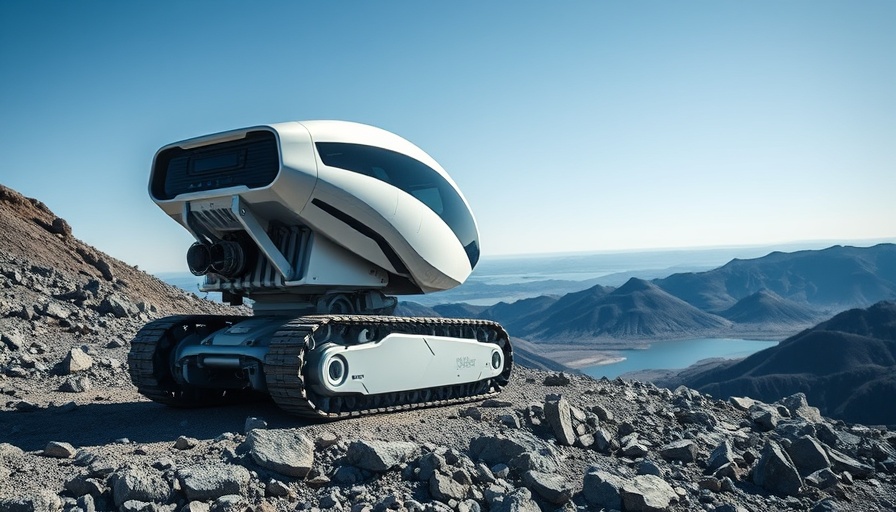
Futuristic moon mining machine on rocky terrain under clear sky

The Rise of Moon Mining: A Breakthrough in Space Innovation

In an exciting development for space exploration and future energy resources, the Seattle-based startup Interlune has unveiled a full-scale prototype of a moon-mining machine designed to harvest helium-3. This rare isotope is seen as a potential fuel for future fusion reactors, a prospect that could revolutionize energy production on Earth.

According to Interlune CEO Rob Meyerson, reliability and performance are crucial when designing equipment for the harsh lunar environment. The excavator prototype is engineered to churn through 110 tons (100 metric tons) of lunar regolith per hour, marking a significant leap in the capabilities of machinery intended for extraterrestrial mining.

Helium-3: The Fuel of the Future

Helium-3 is scarce on Earth but theorized to be abundant on the Moon. Mining this resource is not just a chapter in a science fiction story—it is a tangible opportunity that is being pursued by multiple nations and companies worldwide. Gary Lai, co-founder and CTO of Interlune, noted, “The high-rate excavation needed to harvest helium-3 has never been attempted before.” This illustrates the immense challenges and potential rewards involved in lunar mining.

A Collaborative Approach to Space Mining

The partnership between Interlune and Vermeer, a manufacturing company with a long history in agriculture and industrial equipment, highlights the collaborative spirit driving this endeavor. The prototype's development has built on the success of an earlier, smaller machine, demonstrating the iterative nature of innovation in the field of space technology.

Challenges Ahead: The Economic Feasibility of Moon Mining

Despite the excitement around this venture, experts caution that there are significant financial hurdles to overcome. Ian Crawford, a professor of planetary science at Birkbeck, University of London, claims that the “enormous amounts of investment needed for mining, extraction, and transportation” mean helium-3 may not be readily viable as a fuel source in the near term. As of now, other energy sources may remain more cost-effective.

A Broader Vision for Lunar Economy

The unveiling of this prototype comes amid greater interest in developing a lunar economy. Agencies such as the U.S. Defense Advanced Research Projects Agency (DARPA) are actively exploring ways to facilitate long-term human presence on the Moon through studies like the 10-Year Lunar Architecture (LunA-10) Capability Study. This initiative shows the diverse stakeholders interested in creating infrastructure that can support sustainable industries on the Moon.

The Future of Space Mining is Now

The development of this new moon mining technology suggests that the future of space exploration and energy might be closer than we think. With continued investment and innovation, mining on the Moon could one day provide humanity with access to unprecedented resources.

As we stand at the brink of a new era in space exploration, it’s essential to stay informed about these advancements and consider their implications for our future energy needs.

Future Technologies

2 Views

0 Comments

Write A Comment

*
*
Related Posts All Posts
02.21.2026

Discovering Dusty Galaxies: A Cosmic Insight at the Universe's Edge

Update Understanding the Dusty Galaxies at the Universe's Edge Recent discoveries utilizing the James Webb Space Telescope (JWST) and the Atacama Large Millimeter/sub-millimeter Array (ALMA) have unveiled a collection of 70 dusty, star-forming galaxies located at the very edges of the universe. These extraordinary galaxies were formed less than one billion years after the Big Bang, a finding that’s poised to challenge and possibly rewrite existing theories about cosmic evolution. Unraveling Mysteries of Cosmic Evolution Traditionally, scientists believed that most galaxies formed their stars much later than this. However, the new observations indicate that these galaxies were already enriched with "metals," a term in astronomy that refers to elements heavier than hydrogen and helium. This rich metal content appears much earlier than current theoretical models account for, suggesting that the processes of star formation and metal distribution began sooner than previously thought. Jorge Zavala, the study's lead researcher from the University of Massachusetts, emphasized the significance of these findings: "This collection reflects a critical juncture in cosmic history. It's as if we now have snapshots of the lifecycle of these rare galaxies," he shared. Understanding how these galaxies connect with other star-birthing galaxies could lead to pivotal insights about the birth and evolution of structures in the universe. A Look Back in Time The team's research commenced with ALMA identifying a broader population of 400 dusty galaxies, further refined by the JWST to 70 robust candidates. These galaxies are indicative of a three-phase lifecycle: containing the younger, ultrabright galaxies, these newfound dusty galaxies in their "young adult" phase, and the older quiescent galaxies that have ceased star formation. The Implications for Astronomical Models Combining both observational platforms—JWST and ALMA—allowed astronomers to pinpoint these galaxies' origins to as far back as 500 million years after the Big Bang. Should these galaxies be linked with those previously discovered through JWST, then a critical reevaluation of galactic evolution theories will be paramount. This connection hints that our understanding of star formation must adapt to reflect how these galaxies form much earlier than present models suggest. The research team is keen to pursue further studies to establish these links conclusively, possibly unveiling more about the development of the universe. Broader Context and Future Research Directions In the grand scheme of cosmic exploration and understanding, discovering these dusty galaxies enables astronomers to question existing theories and enrich our comprehension of the universe’s vast history. It also reflects the rapid advancements in observational technology, showcasing how instruments like the JWST and ALMA continue to push the boundaries of our understanding. The implications for innovation in space exploration and astronomy are huge. As we delve deeper into the unexplored regions of the universe, the revelations regarding early galactic structures could pave the way for deeper insights into the origins of elements, potential habitability, and the framework behind cosmic evolution. Exploring these themes opens the door to numerous opportunities for budding astronomers and astrophysicists, encouraging them to engage with the mysteries that the cosmos holds. The potential to redefine our understanding of cosmic history could inspire a new generation of scientific inquiries.

02.21.2026

Discover the Exciting World of Seesaw Proteins That Change Functions

Update What Are Seesaw Proteins? The fascinating world of proteins continues to unveil new surprises! They are complex molecules made of amino acids, and their three-dimensional shapes play a crucial role in how they function. Recently, scientists have introduced the concept of seesaw proteins. Inspired by the simple balance of a seesaw, these proteins can switch between two roles by changing shape. This transformative ability challenges traditional assumptions about protein functionality. Breaking the Mold: Rethinking Protein Functionality Traditionally, the principle known as Anfinsen's dogma suggests that a given amino acid sequence folds into a unique three-dimensional structure. However, breakthroughs in recent years have shown that some proteins can adopt different structures under varying conditions, like chameleon sequences. Seesaw proteins, developed by researchers at the Institute of Science Tokyo, take this concept even further by being designed to switch between two distinct functional states. The Mechanics Behind Seesaw Proteins These artificial seesaw proteins combine a fluorescent protein that emits light with an enzyme important for biological functions. What's remarkable is that only one of these activities is active at any given time. When the protein glows, it doesn’t perform its enzymatic role, and vice versa. This clever design can be controlled by simple changes, such as altering an amino acid, binding with a drug, or changing conditions like pH or salt concentration. This design echoes the balance of a seesaw: when one function is active, the other is dormant. A Vision of the Future: Potential Applications The implications of seesaw proteins are vast! They could revolutionize various fields, including synthetic biology, drug delivery systems, and the development of medical sensors. Imagine a world where proteins could be designed from scratch to switch between functions never before seen in nature. According to Professor Hideki Taguchi, these proteins could lead to new evolutionary experiments guided by design. Reflecting on Progress in Protein Science As we explore the potential of seesaw proteins, it's essential to recognize how far we've come in protein science. Lessons learned from previous research have allowed scientists to redesign proteins with enhanced functionality. For example, researchers at the Baker Lab have been actively engaging in creating proteins that can shapeshift, adding yet another layer of complexity to our understanding of molecular biology. The Quest Continues: What’s Next? While we may still be unraveling the many capabilities of seesaw proteins, one thing is certain: our world of proteins is expanding dramatically. Researchers are now focused on enhancing the dynamic nature of these proteins and finding triggers for their conformational changes. The future is bright for synthetic biology, as these proteins could lead to exciting breakthroughs in healthcare and technology. Takeaway: The Excitement of Innovation Understanding the mechanics behind seesaw proteins not only broadens our grasp of biological processes but also opens doors to innovative solutions for real-world challenges. As more research is unveiled, the possibilities appear endless. Will we one day see designed proteins that address complex health issues or environmental concerns? Only time will tell!

02.19.2026

AI Innovations Narrow Search for Luna 9: Uncovering 60 Years of Mystery

Update Unraveling the Mystery: AI's Role in Locating Luna 9 The search for Luna 9, the first successful soft lander on the moon, has captivated scientists for over six decades. Launched by the Soviet Union on February 3, 1966, Luna 9 made history by transmitting the first images from the moon's surface, yet the exact location of this groundbreaking craft has remained uncertain. Now, two research teams are employing artificial intelligence (AI) to refine their search, promising new insights into this historic mystery. How Machine Learning is Revolutionizing Lunar Exploration Modern technological advancements, particularly in AI, have transformed how researchers approach space artifacts. The machine-learning algorithm named YOLO-ETA, which stands for "You Only Look Once - Extraterrestrial Artifact," was developed by a team at University College London, led by Lewis Pinault. This innovative tool is capable of analyzing thousands of lunar surface images taken by NASA’s Lunar Reconnaissance Orbiter (LRO) to distinguish subtle markers of artificial disturbances that our eyes might miss. The lure of a successful identification lies not just in the data but also in the potential to confirm Luna 9's resting place, which still harbors clues to early space travel and our understanding of lunar geology. Historical Significance of Luna 9's Mission Luna 9's mission marked a pivotal moment in human space exploration. It dispelled doubts about the moon's surface stability, paving the way for subsequent lunar missions, including manned landings. However, the exuberance surrounding its initial success met harsh realities following the landing. Reportedly, the coordinates provided were less than precise, placing the spacecraft somewhere within a 60-mile radius. This large uncertainty cloaked Luna 9 in enigma for many years. The Future of Lunar Investigations The AI models are not merely theoretical exercises. They produced candidate sites that are strikingly close to the original landing coordinates. One proposed location is indeed only about three miles away from the Soviet records, while another is approximately 15 miles distant. Such advancements boost hopes that upcoming images from India's Chandrayaan-2 orbiter might soon provide the clarity needed to pinpoint Luna 9’s final resting location. A definitive identification would not only complete a 60-year-old search but also affirm AI's invaluable role in advancing space exploration. Implications for Future Lunar Missions Should these upcoming assessments yield confirmation of Luna 9, it will be a resounding endorsement for the capabilities of AI in locating historical artifacts on the moon. Furthermore, this case will likely serve as a framework for future lunar exploration analyses, demonstrating how predictive algorithms can optimize missions, enhance our understanding of extraterrestrial environments, and potentially unravel additional mysteries hidden within the lunar surface. As exploration efforts continue, the development of more precise measurement techniques combined with AI will likely inspire confidence in the capabilities of unmanned missions, reinforcing humanity's quest to return to lunar soil and venture further into space.

Terms of Service

Privacy Policy

Core Modal Title

Sorry, no results found

You Might Find These Articles Interesting

T
Please Check Your Email
We Will Be Following Up Shortly
*
*
*