
The Promise of Agrivoltaics in a Changing Climate
As global temperatures rise, the impacts on agriculture are becoming increasingly severe. Farmers, especially those in regions like California’s Central Valley, are facing a double threat: limited water availability and excessive sunlight, both of which can spell disaster for crops. Researchers at UC Davis are exploring an innovative solution: agrivoltaics, a method that integrates solar energy generation with agricultural production.
What is Agrivoltaics?
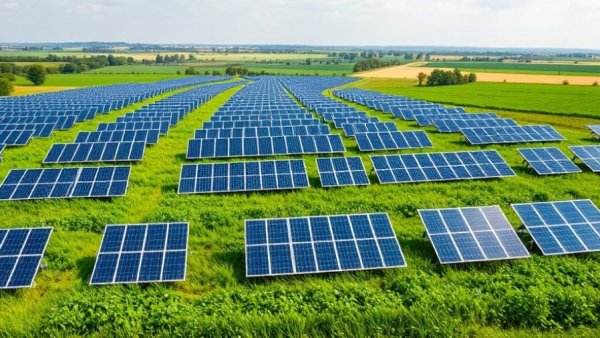
Agrivoltaics is a groundbreaking approach that employs solar panels on farm fields, serving dual purposes—harvesting sunlight for energy while simultaneously providing shade for crops. The concept is simple yet profound: by shielding crops from harsh sunlight, farmers can reduce the need for irrigation, thereby conserving precious water resources. For instance, Majdi Abou Najm, a soil biophysics professor at UC Davis, explains that when plants receive less direct sunlight, they require less water, reducing their stress and vulnerability to heat-induced diseases.
A Closer Look at the Research
At the UC Davis agrivoltaic research site, various solar panel designs are being tested side by side to determine their effectiveness in different growing conditions. These include vertical solar panels that capture light from multiple angles and special fixed-tilt arrays that use red-tinted panels, which allow red light to pass through for optimal photosynthesis while utilizing other wavelengths for energy production. This multi-faceted approach aims to maximize both light optimization and crop productivity.
Testing Water Use Efficiency
The impact of agrivoltaics on water use efficiency is being meticulously researched over a three-year period. The project includes trials on both summer and winter crops, allowing researchers to analyze how these systems interact with diverse agricultural cycles. Doctoral student Gavin Chaboya is measuring how much water tomato plants absorb from the soil and release back into the atmosphere, a process known as evapotranspiration. By understanding these dynamics, researchers hope to identify the most efficient methods of using water resources.
Potential Benefits for Farmers
The implications of agrivoltaics extend beyond individual farms; they offer a viable path toward sustainable agricultural practices in an era of climate uncertainty. With the global population projected to reach 9.7 billion by 2050, integrating solar energy and agriculture could allow farmers to produce food on increasingly limited arable land. Additionally, agrivoltaics can provide farmers with an additional revenue stream from solar energy while still maintaining crop yields.
Challenges and Future Directions
While the research is promising, there are challenges to widespread adoption of agrivoltaics. Initial setup costs for solar installations can be significant, and regulatory hurdles exist around land use and energy production. However, as the technology develops and becomes more affordable, agrivoltaics may hold the key to more resilient farming practices across the globe, combining the best of sustainable energy and agricultural innovation.
A Call for Innovation and Collaboration
As we ponder the implications of agrivoltaics for our future, it's imperative that farmers, researchers, and policymakers collaborate to harness these advancements effectively. Through innovative solutions like agrivoltaics, we can strive not just for agricultural productivity but also for a more sustainable and equitable food system.





Write A Comment