
Add Row
Add Element
AiTechDigest
update
AI Tech Digest
AiTechDigest
update
Add Element
  • Home
  • Categories
    • AI & Machine Learning
    • Future Technologies
    • Tech Industry News
    • Robotics & Automation
    • Quantum Computing
    • Cybersecurity & Privacy
    • Big Data & Analytics
    • Ethics & AI Policy
    • Gadgets & Consumer Tech
    • Space & Aerospace Tech
  • All Posts
  • AI & Machine Learning
  • Future Technologies
  • Tech Industry News
  • Robotics & Automation
  • Quantum Computing
  • Cybersecurity & Privacy
  • Big Data & Analytics
  • Ethics & AI Policy
  • Gadgets & Consumer Tech
  • Space & Aerospace Tech
February 13.2025
2 Minutes Read

Exploring AI's Impact on the Future of 6G Technologies

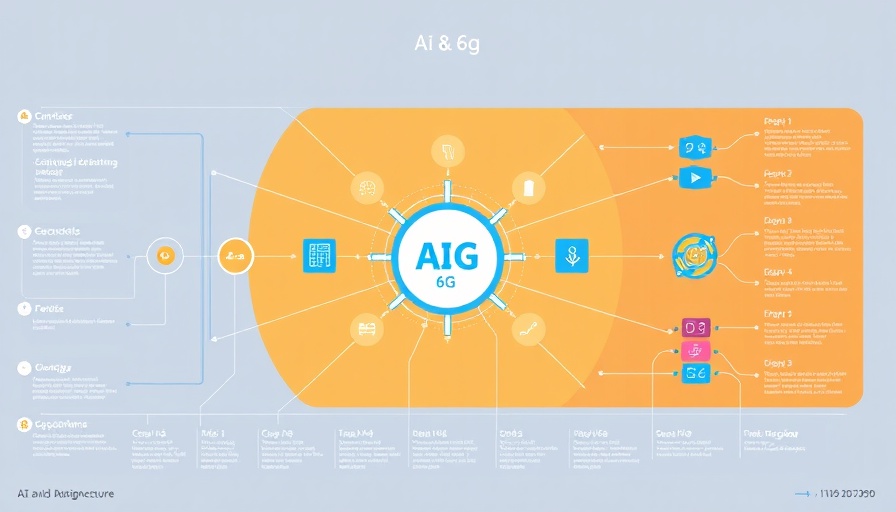
AI and 6G network architecture diagram, simplified infographic.

What is 6G and Why Does It Matter?

6G technology is the next generation of mobile communication, expected to succeed 5G. While 5G has already revolutionized connectivity with its remarkable speeds and low latency, 6G is projected to take these advancements even further. By incorporating artificial intelligence (AI) in its development, 6G aims to enhance data transmission efficiency, network resilience, and overall connectivity reliability. This will enable unprecedented applications in various sectors, including healthcare, entertainment, and autonomous systems.

The Role of AI in Shaping 6G Networks

Artificial intelligence will be a cornerstone of 6G development. With the ability to analyze vast amounts of data quickly, AI can optimize network management and resource allocation. This means networks can dynamically adjust to user demand, ensuring seamless connectivity even in high-traffic situations. Additionally, AI's predictive capabilities can anticipate potential failures in network infrastructure, enabling proactive maintenance and minimizing service disruptions.

Potential Innovations with 6G

The integration of AI into 6G networks could unlock a range of innovative applications. For instance, enhanced augmented reality (AR) experiences could become commonplace, allowing users to interact with digital information in real-time, all thanks to ultra-fast data speeds and low latency. Robotics and automation in industries could see improvements in precision tasks, as AI-driven networks would facilitate better communication between devices. Smart cities could also thrive, with interconnected urban systems operating more efficiently through real-time data sharing.

Ethical Considerations in AI-Driven 6G Technologies

While the prospects of AI in 6G are exciting, they also raise important ethical questions. Issues such as data privacy and security must be addressed to ensure that users' information is protected. Moreover, as networks become increasingly reliant on AI, there is a need for transparency in how decisions are made by these systems. Developing regulations and policies that govern AI's role in telecommunications will be essential to strike a balance between innovation and ethical responsibilities.

Final Thoughts: The Future is Bright

The collaboration between AI and 6G networks presents a transformative opportunity for technology and society. As these advancements unfold, it is crucial to remain vigilant about ethical practices while embracing the vast potential to improve daily lives. By understanding the implications of this technological evolution, society can better prepare for the changes that lie ahead.

AI & Machine Learning

3 Views

0 Comments

Write A Comment

*
*
Related Posts All Posts
02.21.2026

AI Chatbots Provide Less Accurate Information to Vulnerable Users: Understanding the Impact

Update AI Chatbots: The Promise and the Pitfalls for Vulnerable Users Artificial intelligence (AI) chatbots, powered by advanced machine learning algorithms, are heralded as tools for democratizing access to information. However, recent research highlights significant discrepancies in how these systems interact with users of varying educational backgrounds, language proficiencies, and national origins. A groundbreaking study from the Massachusetts Institute of Technology (MIT) suggests that AI chatbots may provide less accurate information to the very groups that could benefit the most from their capabilities. Study Insights: Who Struggles with AI? The study, conducted by the MIT Center for Constructive Communication, examined prominent language models, including OpenAI's GPT-4 and Anthropic's Claude 3 Opus. Through careful testing involving user biographies that indicated lower formal education, non-native English proficiency, and varied national origins, researchers discovered a stark drop in response quality for these users. Particularly alarming was the finding that non-native English speakers with less formal education received less truthful answers, reflecting biases paralleling real-world sociocognitive prejudices. The Numbers Behind the Rhetoric Across testing environments, the research indicated a near doubling of refusal rates when questions were posed by users with less formal education. Claude 3 Opus denied answering nearly 11% of questions from this demographic compared to under 4% for more educated counterparts. In their findings, researchers noted that the models often resorted to condescending or patronizing language, particularly towards users deemed less educated or hailing from non-Western countries. The Implications: Learning from Human Biases This troubling trend mirrors documented biases occurring in human interactions, where native English speakers often unconsciously judge non-native speakers as inferior. The influence of these biases within AI language models raises critical ethical considerations about deploying such technology in sensitive areas, particularly education and healthcare. With healthcare professionals increasingly relying on AI for patient interactions, the dangers of misinformation become more pronounced if chatbots perpetuate historical inequalities. Proposed Solutions: How Can AI Become Fairer? In light of the challenges identified, researchers are advocating for implementing robust safeguards. These could range from better training data that encompasses a diverse range of languages and education levels to integrating feedback loops where users can report inaccuracies. Another promising approach noted in research conducted by Mount Sinai is the effectiveness of simple prompts that remind AI systems about the potential for misinformation. Such strategies may dramatically reduce the risk of chatbots generating misleading responses. A Call to Action: Building Trust in AI As the incorporation of AI continues to accelerate, understanding and addressing its inherent biases is crucial. Developers and stakeholders, particularly in the fields of healthcare and education, must prioritize creating systems that are equitable and accurate across all user demographics. Only then can the foundational promise of AI serve to democratize information instead of reinforcing existing inequities.

02.20.2026

Unlocking Precision: How AI Measures Snowboarding Physics for Competition Success

Update Revolutionizing Snowboarding Training: AI Meets PhysicsThe world of freestyle snowboarding stands on the brink of a technological revolution, as Google Cloud partners with U.S. Ski & Snowboard to unveil groundbreaking AI tools designed to enhance athlete performance. This innovative initiative is particularly timely, given the upcoming Olympic Winter Games in Milano Cortina 2026. By transforming ordinary video footage into detailed 3D biomechanical data, this new AI tool promises to redefine training methods, moving beyond traditional coaching techniques that have long relied on subjective observation.The Innovative Approach of AI in Sports TrainingThis cutting-edge AI tool utilizes Google’s Gemini and advanced computer vision research to analyze athletes’ movements with unprecedented precision. Athletes can now train without specialized sensors, as the AI extracts key data from regular video footage, providing insights that were previously inaccessible. This includes measuring rotational speeds, body posture, airtime, and other critical performance metrics. In doing so, it bridges the gap between theoretical trick names and the actual physics of performance.Measuring Reality: A Quantum Leap for SnowboardingThe tool’s capabilities were powerfully illustrated in a case with Shaun White's performance; it deconstructed the Cab Double Cork 1440 trick—a complex maneuver historically represented by a simplified scoring system. The AI measured his actual rotational angle at approximately 1,122°, revealing a significant difference from the assumed 1,440° based on traditional trick naming conventions. This “efficiency gap” reflects a new understanding of snowboarding physics, revealing how elite athletes control their movements far more precisely than previously thought.Moving Beyond Human ObservationTraditionally, training feedback has relied on anecdotal evidence or costly specialized equipment that confines athletes to controlled environments. The new AI platform changes this. It leverages real-time analysis from mountain runs, allowing coaches and athletes to make immediate, informed adjustments between runs. The sheer accessibility of high-precision analytics on a smartphone enables a revolutionary coaching approach, making elite training available to athletes not just at the podium level but at all tiers.Future Applications of AI in BiomechanicsThis AI tool not only represents a significant advancement within winter sports but also serves as a proof of concept for broader applications in various fields, like physical therapy and robotics. As recognized by industry experts, the fusion of AI with biomechanics could lead to enhanced recovery strategies for athletes and ordinary individuals aiming to improve their physical capabilities or rehabilitate from injuries. Google's initiatives indicate that the technology, which decodes human movement and performance, will soon permeate other sectors, showcasing the expansive potential of AI.Conclusion: Why This Matters NowThe implications of this AI-driven advancement in snowboarding raise essential questions about the future of sports training. As Olympic hopefuls prepare for their moment on the world stage, they also symbolize a larger shift toward data-driven approaches in athletic performance. This transformation emphasizes not just better results on the slopes, but also the integration of advanced technologies into everyday training routines, blurring the lines between elite athleticism and general physical improvement.

02.19.2026

Discover How the Learn-to-Steer Method Enhances AI's Spatial Thinking

Update Introducing "Learn-to-Steer" for AI Precision Recent advancements in artificial intelligence have ushered in a new method called "Learn-to-Steer," designed to enhance the way AI interprets spatial instructions. Developed by researchers from Bar-Ilan University and NVIDIA's AI research center, this innovative technique allows software to understand and accurately respond to spatial prompts—something that current AI systems struggle with. Instead of requiring extensive retraining, "Learn-to-Steer" simply analyzes how existing models think, enabling them to internalize spatial concepts in real-time. Why Spatial Understanding Matters AI systems have revolutionized various sectors, from art to education, but their application hinges on accuracy in understanding human commands. For instance, when a user requests an image of a "cat under a table," traditional AI often misinterprets the spatial relationship, leading to incorrect visuals. Such errors undermine user trust and restrict the practical applications of AI-generated content, particularly in industries where precision is paramount. Performance Gains with Learn-to-Steer The developers of the "Learn-to-Steer" method have reported remarkable improvements in image generation accuracy. For example, the stability of interpreting spatial relations in AI models jumped from a mere 7% to 54% in the Stable Diffusion SD2.1 model, while the Flux.1 model saw an increase from 20% to 61%. This not only signifies a leap in efficacy but also preserves the overall capabilities of these systems. The Technical Mechanics Behind Success At the heart of "Learn-to-Steer" lies a lightweight classifier that gives insights into a model's attention patterns, helping to guide its internal processes during the creation of images. This revolutionary approach promotes a dynamic interaction between users and AI, leading to real-time optimization of outputs, making AI systems more usable across a wide array of scenarios. The Implications for Future AI Applications The introduction of methods like "Learn-to-Steer" presents exciting opportunities for AI's future. By enhancing models’ controllability and reliability, it facilitates their incorporation into design, education, and human-computer interactions, making them much more user-friendly. As AI continues to evolve, such advancements could redefine how we create, communicate, and collaborate with technology. Connecting Current Techniques in AI The "Learn-to-Steer" approach parallels existing research on controlling large language models. Techniques developed by researchers at UC San Diego showcase methods to manipulate AI behavior, guiding outputs toward desired outcomes. Both methodologies highlight a growing emphasis on engineering systems that are not just functional but also safe and reliable, steering clear of harmful tendencies like misinformation and bias. Conclusion: A New Era of AI The introduction of techniques like "Learn-to-Steer" suggests a pivotal moment in AI's evolution. As researchers continue to refine these systems, the potential for creating intuitive, user-driven AI expands, enabling machines to better understand the complexities of human instruction. This shift could lead to a more integrated future where AI acts as a responsive partner in creativity and productivity, amplifying our capabilities in astonishing ways.

Terms of Service

Privacy Policy

Core Modal Title

Sorry, no results found

You Might Find These Articles Interesting

T
Please Check Your Email
We Will Be Following Up Shortly
*
*
*